Peter's electronic projects Peter's electronic projects
As technology continues to evolve, we can expect new methods and tools to emerge for bypassing FRP on Samsung devices. It's essential to stay up-to-date with the latest developments and research the potential risks and consequences before attempting to bypass FRP.
The information provided in this report is for educational purposes only. The author and publisher are not responsible for any damage or consequences resulting from the use of this information.
Factory Reset Protection (FRP) is a security feature implemented by Google to protect Android devices from unauthorized access. While it's an essential feature for device security, it can become a significant obstacle for users who forget their Google account credentials or purchase a second-hand device with FRP enabled. In this report, we'll explore the new method for bypassing FRP on Samsung devices in 2025.
The new method for bypassing FRP on Samsung devices in 2025 involves using a combination of software and hardware techniques. Here's a step-by-step overview of the process:
FRP is a feature that locks a device to a Google account, making it difficult for someone to use the device if they don't know the account credentials. When a device is reset, FRP kicks in, requiring the user to enter the Google account username and password associated with the device.
The new method for bypassing FRP on Samsung devices in 2025 provides a potential solution for users who are locked out of their devices. However, it's essential to consider the potential risks and consequences before attempting to bypass FRP. Users should exercise caution and thoroughly research the method before proceeding.
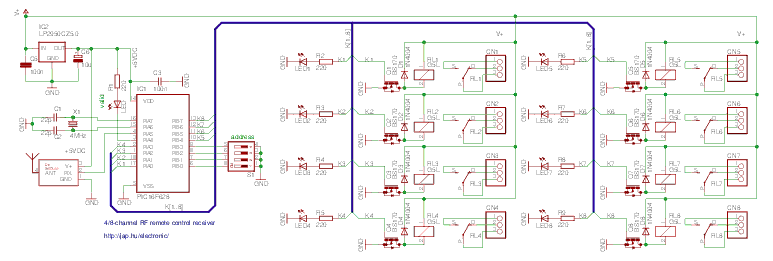
 Try it now, before building! Click on the transmitter buttons with the
green
labels
on the left and see how the receiver outputs (K1-K8) change. Change
the number of transmitter or receiver channels. Switch the receiver
output type between latched and momentary.
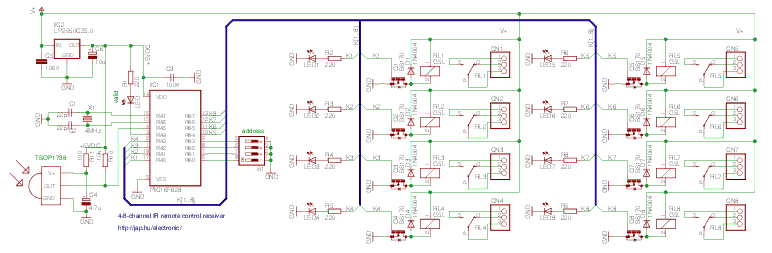
Try it now, before building! Click on the transmitter buttons with the
green
labels
on the left and see how the receiver outputs (K1-K8) change. Change
the number of transmitter or receiver channels. Switch the receiver
output type between latched and momentary.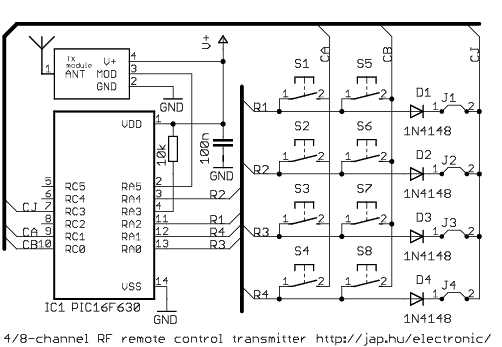
| part | description |
| C1 |
100nF ceramic capacitor |
| R1 |
10k resistor (1/8W) |
| D1-D4 | 1N4148 diode (optional) |
| S1-S8 |
tact switch, DTSM 61N or similar |
| IC1 | PIC16F630 or PIC16F676 microcontroller, pre-programmed |
| TXMOD |
radio
transmitter module, see text (hardware) |
| B1 |
battery between 2-5.5VDC (check TXMOD specs for valid voltage range) |
| part | description |
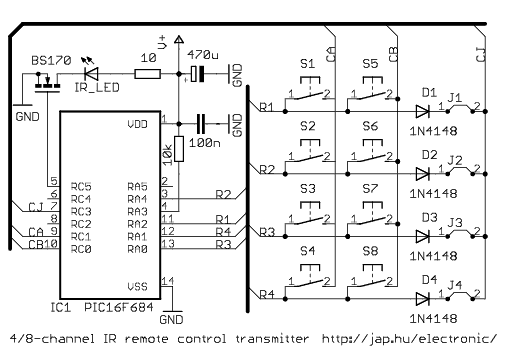
| C1 |
100nF ceramic capacitor |
| C2 |
470 uF 6.3V, electrolytic
capacitor |
| R1 |
10k resistor (1/8W) |
| R2 |
10 ohm resistor (1/4W) |
| D1-D4 | 1N4148 diode (optional) |
| D5 |
IR transmitter LED |
| Q1 |
BSS138 or similar N-MOSFET |
| S1-S8 |
tact switch, DTSM 61N or similar |
| IC1 | PIC16F684 microcontroller, pre-programmed |
| B1 |
battery between 2-5.5VDC (CR2032, 3.6V LiIon battery or 3xAA
batteries) |
| please
observe the corresponding address configuration! |
|
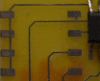 transmitter: no diodes connected |
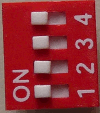 receiver: switches all ON |
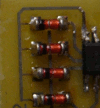 transmitter: all diodes connected |
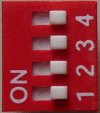 receiver: switches all OFF |
parts list
| part | description |
| C1, C2 | 22pF ceramic capacitor |
| C3, C5 | 100nF ceramic capacitor |
| C6 | 10uF 6.3V electrolytic capacitor |
| CN1-CN8 | PCB terminal block, 3-way (DG301) |
| D1-D8 | 1N4004 diode |
| IC1 | PIC16F627 or PIC16F628 or PIC16F627A or PIC16F628A microcontroller, pre-programmed |
| IC2 | LP2950CZ5.0 voltage regulator |
| LED | 3mm LED (green) |
| LED1-LED8 | 3mm LED (red) |
| Q1-Q8 | BS170 N-channel mosfet transistor |
| R1-R9 | 220R resistor (1/8W) |
| RL1-RL8 | G5LE relay, see text for coil voltage selection |
| S1 | piano DIP switch, 4-way |
| X1 | 4MHz HC49 crystal |
| RXMOD | 3-pin radio receiver module, see text (hardware) |
| please
observe the corresponding address configuration! |
|
| transmitter: no diodes connected |
receiver: switches all ON |
| transmitter: all diodes connected |
receiver: switches all OFF |
As technology continues to evolve, we can expect new methods and tools to emerge for bypassing FRP on Samsung devices. It's essential to stay up-to-date with the latest developments and research the potential risks and consequences before attempting to bypass FRP.
The information provided in this report is for educational purposes only. The author and publisher are not responsible for any damage or consequences resulting from the use of this information.
Factory Reset Protection (FRP) is a security feature implemented by Google to protect Android devices from unauthorized access. While it's an essential feature for device security, it can become a significant obstacle for users who forget their Google account credentials or purchase a second-hand device with FRP enabled. In this report, we'll explore the new method for bypassing FRP on Samsung devices in 2025.
The new method for bypassing FRP on Samsung devices in 2025 involves using a combination of software and hardware techniques. Here's a step-by-step overview of the process:
FRP is a feature that locks a device to a Google account, making it difficult for someone to use the device if they don't know the account credentials. When a device is reset, FRP kicks in, requiring the user to enter the Google account username and password associated with the device.
The new method for bypassing FRP on Samsung devices in 2025 provides a potential solution for users who are locked out of their devices. However, it's essential to consider the potential risks and consequences before attempting to bypass FRP. Users should exercise caution and thoroughly research the method before proceeding.
LATCH_MASK EQU B'00001111' sets channels 8-5 to momentary
and
channels 4-1 to latched (toggle) mode. Then use the compiler (MPLAB or
gputils) to
assemble the code.clrf
0x91 ;
ANSEL